
 7
7
 0
0
A journey through the study of the human figure in Greek sculpture, where the human being is understood as a reflection of the divine and an expression of ideal perfection. Archaic sculpture is examined through the frontal and austere poses of its kouroi and korai, in the abstract stillness of their gaze and smile, endowed with a superhuman inner calm.
The Doric current is presented through the solidity and rigidity of its massive volumes, with squared forms that recall the structural strength of Doric architecture. Ionic sculpture, on the other hand, surprises us with its lightness and elegance, thanks to the development of a new sensitivity toward natural forms.
The journey continues with the search for balance and the study of movement in the Severe Style, leading to the exploration of equilibrium between stillness and motion in Myron, and to Polykleitos’ Canon, which taught how every part of the figure must relate to the whole according to precise proportional ratios.
With Lysippos, movement is rendered through unstable balance and a figure articulated in space, allowing the sculpture to be viewed from multiple perspectives.
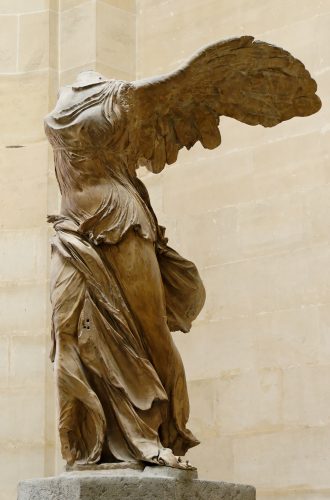
Our journey concludes with Hellenistic sculpture and its expression of the dramatic sense of existence, its realism. A new need emerges: to represent the world as it truly is, capturing the full range of human emotions. With Hellenistic art, it becomes clear that the rules of classical harmony can no longer evoke the same emotions as asymmetry, immediacy, and spontaneity.
Click the links below to download the lessons in PDF:

